
IELTS Listening Section 3 & 4: Latihan Audio & Strategi

IELTS Listening Section 3 dan Section 4 adalah dua bagian terakhir yang menggunakan konteks akademik dan memiliki tingkat kesulitan paling tinggi. Kalau di Section 1 dan 2 Kamu mendengarkan informasi faktual yang spesifik, di Section 3 dan 4 Kamu harus menangkap opini, argumen, perbandingan, dan alur pemikiran akademik.
Daftar Isi
Kedua section ini adalah tempat di mana perbedaan antara band 6.5 dan band 7.0 ditentukan. Artikel ini menyediakan latihan audio dari Cambridge IELTS 19 Test 1 untuk kedua section beserta strategi khusus. Section 3 berupa diskusi antara mahasiswa tentang proyek akhir mereka, sedangkan Section 4 berupa kuliah arkeologi tentang situs Neolitik di Irlandia.
Section 3: Food Science Student Projects
Konteks
Kamu akan mendengar dua mahasiswa ilmu pangan, Marie dan Colin, mendiskusikan proyek akhir tahun mereka. Section ini menggabungkan tiga jenis soal: multiple choice dengan pilihan ganda (Questions 21-22 dan 23-24), single choice (Question 25), dan matching (Questions 26-30).
Audio Section 3
Questions 21 and 22
Choose TWO letters, A-E.
Which TWO things did Colin find most satisfying about his bread reuse project?
A. receiving support from local restaurants
B. finding a good way to prevent waste
C. overcoming problems in a basic process
D. experimenting with designs and colours
E. learning how to apply 3-D printing
Questions 23 and 24
Choose TWO letters, A-E.
Which TWO ways do the students agree that touch-sensitive sensors for food labels could be developed in future?
A. for use on medical products
B. to show that food is no longer fit to eat
C. for use with drinks as well as foods
D. to provide applications for blind people
E. to indicate the weight of certain foods
Questions 25-30
What is the students’ opinion about each of the following food trends?
Choose SIX answers from the box and write the correct letter, A-H, next to Questions 25-30.
| Opinions | |
|---|---|
| A | This is only relevant to young people. |
| B | This may have disappointing results. |
| C | This already seems to be widespread. |
| D | Retailers should do more to encourage this. |
| E | More financial support is needed for this. |
| F | Most people know little about this. |
| G | There should be stricter regulations about this. |
| H | This could be dangerous. |
Food trends
25. Use of local products ………
26. Reduction in unnecessary packaging ………
27. Gluten-free and lactose-free food ………
28. Use of branded products related to celebrity chefs ………
29. Development of ‘ghost kitchens’ for takeaway food ………
30. Use of mushrooms for common health concerns ………
Klik untuk melihat jawaban Section 3
21 & 22. B dan D (IN EITHER ORDER)
23 & 24. A dan E (IN EITHER ORDER)
25. D
26. G
27. C
28. B
29. F
30. H
Klik untuk melihat transcript Section 3
Marie: I haven’t seen you for a bit, Colin.
Colin: No, I’ve been busy with my project.
Marie: You’re making a vegan alternative to eggs, aren’t you? Something that doesn’t use animal products.
Colin: Yes, I’m using chickpeas. I had two main aims when I first started looking for an alternative to eggs. But actually, I’ve found chickpeas have got more advantages.
Marie: Right, but how about your project on reusing waste food? You were looking at bread, weren’t you?
Colin: Yes, it’s been hard work, but I’ve enjoyed it. The basic process was quite straightforward — breaking the stale bread down to a paste, then reforming it.
Marie: But you were using 3D printing, weren’t you, to make the paste into biscuits?
Colin: Yeah, I’d used that before, but in this project I had time to play around with different patterns for the biscuits and finding how I could add fruit and vegetables to make them a more appetizing colour. And I was really pleased with what I managed to produce.
Marie: It must have been a great feeling to make something appetizing out of bits of old bread that would have been thrown away otherwise.
Colin: It was, and I’m hoping that some of the restaurants in town will be interested in the biscuits. I’m going to send them some samples.
Marie: I came across something on the internet yesterday that might interest you. It was a company that developed touch-sensitive sensors for food labels.
Colin: Mm.
Marie: It’s a special sort of label on the food package. When the label’s smooth, the food is fresh. And then when you can feel bumps on the label, that means the food’s gone bad. It started off as a project to help visually impaired people know whether food was fit to eat or not.
Colin: Interesting. So just solid food?
Marie: No. Things like milk and juice as well. But actually, I thought it might be really good for drug storage in hospitals and pharmacies.
Colin: Right. And coming back to food, maybe it would be possible to use it for other things besides freshness. Like how many kilograms a joint of meat is, for example.
Marie: Yes. There’s all sorts of possibilities.
Marie: I was reading an article about food trends, predicting how eating habits might change in the next few years.
Colin: Oh, things like more focus on local products?
Marie: That seems so obvious, but the shops are still full of imported foods. They need to be more proactive to address that and somehow motivate consumers to change.
Colin: Yes, one thing everyone’s aware of is the need for a reduction in unnecessary packaging, but just about everything you buy in supermarkets is still covered in plastic. The government needs to do something about it.
Marie: Absolutely. It’s got to change.
Colin: Do you think there’ll be more interest in gluten and lactose free food for people with allergies or food intolerances?
Marie: I don’t know. Lots of people I know have been buying that type of food for years now.
Colin: Yes, even if they haven’t been diagnosed with an allergy. That’s right.
Marie: One thing I’ve noticed is the number of branded products related to celebrity chefs. People watch them cooking on TV and then buy things like spice mixes or frozen foods with the chef’s name on.
Colin: I bought something like that once, but I won’t again.
Marie: Yeah, I bought a ready-made spice mix for chicken, which was supposed to be used by a chef I’d seen on television, and it didn’t actually taste of anything.
Colin: Hmm. Did the article mention ghost kitchens used to produce takeaway food?
Marie: No. What are they?
Colin: Well, they might have the name of a restaurant, but actually, they’re a cooking facility just for delivery meals. The public don’t ever go there.
Marie: But people aren’t aware of that. It’s all kept very quiet, so people don’t realise the food’s not actually from the restaurant.
Colin: Right.
Marie: Did you know more and more people are using all sorts of different mushrooms now to treat different health concerns, things like heart problems?
Colin: Mm. They might be taking a big risk there.
Marie: Yes. It’s hard to know which varieties are safe to eat.
Strategi Section 3
Untuk soal “Choose TWO”: Baca semua 5 opsi sebelum audio. Tandai opsi yang Kamu dengar. Ingat bahwa jawaban bisa muncul dalam urutan apa pun. Pada soal 21-22, Colin menyebut “experimenting with designs and colours” (D) dan Marie mengomentari tentang “preventing waste” (B) yang Colin setujui.
Untuk soal matching opinions: Ini tipe soal tersulit di Section 3. Kamu harus mendengarkan nada dan evaluasi, bukan hanya fakta. Saat Marie bilang “shops are still full of imported foods, they need to be more proactive” tentang local products, itu cocok dengan opsi D (retailers should do more). Saat Colin bilang “the government needs to do something about” packaging, itu cocok dengan G (stricter regulations).
Section 4: Céide Fields — Situs Neolitik di Irlandia
Konteks
Kamu akan mendengar seorang mahasiswa arkeologi memberikan presentasi tentang Céide Fields, salah satu situs Neolitik terbesar di dunia yang terletak di barat laut Irlandia. Jenis soal: note completion dengan batas ONE WORD ONLY. Ini section tersulit karena audio berjalan tanpa jeda dan topiknya sangat akademis.
Audio Section 4
Questions 31-40: Complete the notes below. Write One Word only for each answer.
Céide Fields
• an important Neolithic archaeological site in the northwest of Ireland
Discovery
• In the 1930s, a local teacher realised that stones beneath the bog surface were once 31 ………………
• His 32 ……………… became an archaeologist and undertook an investigation of the site:
— a traditional method used by local people to dig for 33 ……………… was used to identify where stones were located
— carbon dating later proved the site was Neolithic.
• Items are well preserved in the bog because of a lack of 34 ………………
Neolithic farmers
• Houses were 35 ……………… in shape and had a hole in the roof.
• Neolithic innovations include:
— cooking indoors
— pots used for storage and to make 36 ………………
• Each field at Céide was large enough to support a big 37 ………………
• The fields were probably used to restrict the grazing of animals — no evidence of structures to house them during 38 ………………
Reasons for the decline in farming
• a decline in 39 ……………… quality
• an increase in 40 ………………
Klik untuk melihat jawaban Section 4
31. walls
32. son
33. fuel
34. oxygen
35. rectangular
36. lamps
37. family
38. winter
39. soil
40. rain
Klik untuk melihat transcript Section 4
Student: For my presentation today, I’m going to talk about the Céide Fields in the northwest of Ireland — one of the largest Neolithic sites in the world. I recently visited this site and observed the work that is currently being done by a team of archaeologists there.
The site was first discovered in the nineteen-thirties by a local teacher, Patrick Caulfield. He noticed that when local people were digging in the bog, they were constantly hitting against what seemed to be rows of stones. He realised that these must be walls, and that they must be thousands of years old for them to pre-date the bog which subsequently grew over them. He wrote to the National Museum in Dublin to ask them to investigate, but no one took him seriously.
It wasn’t until forty years later when Patrick Caulfield’s son Seamus, who had become an archaeologist by then, began to explore further. He inserted iron probes into the bog to map the formation of the stones — a traditional method which local people had always used for finding fuel buried in the bog for thousands of years. Carbon dating later proved that the site was over five thousand years old and was the largest Neolithic site in Ireland.
Thanks to the bog which covers the area, the remains of the settlement at Céide Fields are extremely well preserved. A bog is ninety percent water; its soil so saturated that when the grasses and heathers that grow on its surface die, they don’t fully decay but accumulate in layers. Objects remain so well preserved in these conditions because of the acidity of the peat and the deficiency of oxygen. At least one hundred and seventy-five days of rain a year are required for this to happen. This part of Ireland gets an average of two hundred and twenty-five days.
The Neolithic farmers at Céide would have enjoyed several centuries of relative peace and stability. Neolithic farmers generally lived in larger communities than their predecessors, with a number of houses built around a community building. As they lived in permanent settlements, Neolithic farmers were able to build bigger houses. These weren’t round, as people often assume, but rectangular, with a small hole in the roof that allowed smoke to escape. This is one of many innovations and indicates that the Neolithic farmers were the first people to cook indoors.
Another new technology that Neolithic settlers brought to Ireland was pottery. Fragments of Neolithic pots have been found in Céide and elsewhere in Ireland. The pots were used for many things — as well as for storing food, pots were filled with a small amount of fat, and when this was set alight, they served as lamps.
It’s thought that the Céide Fields were mainly used as paddocks for animals to graze in. Evidence from the Céide Fields suggests that each plot of land was of a suitable size to sustain an extended family. They may have used a system of rotational grazing in order to prevent overgrazing and to allow for plant recovery and regrowth. This must have been a year-round activity, as no structures have been found which would have been used to shelter animals in the winter.
However, archaeologists believe that this way of life at Céide ceased abruptly. Why was this? Well, several factors may have contributed to the changing circumstances. The soil would have become less productive and led to the abandonment of farming. The crop rotation system was partly responsible for this, as it would have been very intensive and was not sustainable. But there were also climatic pressures too. The farmers at Céide would have enjoyed a relatively dry period, but this began to change and the conditions became wetter as there was a lot more rain. It was these conditions that encouraged the bog to form over the area which survives today.
Strategi Section 4
Baca SEMUA soal 31-40 sebelum audio dimulai. Section 4 tidak punya jeda, jadi Kamu harus sudah familiar dengan seluruh 10 pertanyaan. Prediksi jenis kata: “stones were once ___” → kata benda (walls), “houses were ___ in shape” → kata sifat (rectangular).
Ikuti sinyal transisi: Pembicara menggunakan frasa seperti “It wasn’t until…”, “Another new technology…”, “However, archaeologists believe…” untuk menandakan perpindahan topik. Setiap transisi biasanya menandakan kelompok soal berikutnya.
ONE WORD ONLY sangat ketat. Kalau audio bilang “deficiency of oxygen” dan kalimat soal sudah menulis “a lack of ___”, jawabannya hanya “oxygen” — satu kata. Perhatikan bahwa kalimat soal sering memarafrase teks audio.
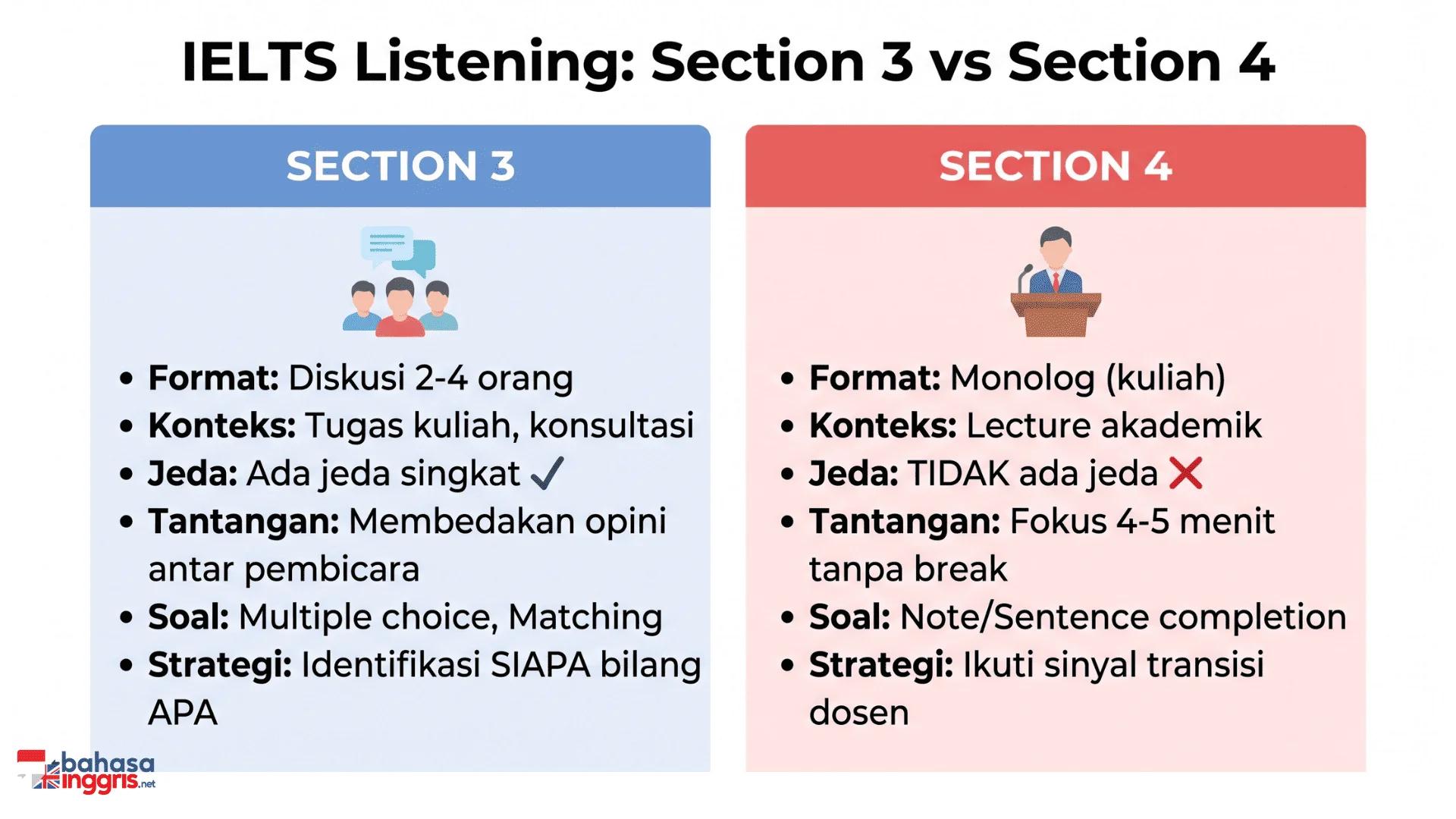
Perbandingan Section 3 vs Section 4
| Aspek | Section 3 | Section 4 |
|---|---|---|
| Format | Diskusi 2 mahasiswa | Monolog (presentasi) |
| Konteks | Proyek akhir tahun: food science | Presentasi arkeologi: Céide Fields |
| Jeda di tengah | Ada jeda singkat | Tidak ada jeda |
| Tantangan utama | Membedakan opini Marie vs Colin + matching | Menjaga fokus selama monolog panjang + ONE WORD limit |
| Jenis soal | Multiple choice (choose two), Matching opinions | Note completion (one word only) |
| Strategi kunci | Dengarkan siapa bilang apa, perhatikan nada evaluatif | Ikuti sinyal transisi, prediksi jenis kata |
(FAQ) Frequently Asked Questions
Kenapa Section 3 dan 4 jauh lebih sulit?
Karena tiga alasan: kosakata yang lebih akademik (Neolithic, archaeologist, rotational grazing), kecepatan bicara yang lebih cepat, dan kompleksitas informasi yang lebih tinggi. Di Section 3 Kamu harus melacak opini dua pembicara, dan di Section 4 Kamu harus mengikuti kuliah panjang tanpa jeda.
Berapa soal yang harus benar di Section 3 dan 4 untuk band 7?
Untuk total band 7.0, Kamu butuh minimal 30 benar dari 40 keseluruhan. Kalau Kamu sudah mengamankan 18-20 benar di Section 1 dan 2, Kamu hanya perlu 10-12 benar dari 20 soal di Section 3 dan 4. Itu berarti boleh salah 8-10 soal di dua section tersulit dan tetap band 7.
Penutup
Section 3 dan 4 memang menantang, tapi dengan latihan rutin menggunakan audio akademik seperti di atas, Kamu bisa meningkatkan performa secara signifikan. Di Section 3, fokus pada siapa bilang apa dan evaluasi mereka. Di Section 4, baca semua soal sebelum audio dan ikuti sinyal transisi pembicara.
Pastikan Kamu sudah menguasai Section 1 & 2 terlebih dahulu. Baca juga Panduan IELTS Listening untuk strategi keseluruhan. Untuk skill lainnya: Speaking Part 1, Part 2, Part 3, Writing Task 1, Writing Task 2. Kalau Kamu butuh bimbingan intensif dengan tutor, cek kelas IELTS online di Bahasa Inggris Net.

IELTS Listening Section 1 & 2: Latihan Audio &...

Panduan IELTS Reading: Teknik Skimming, Scanning & Strategi

