
IELTS Listening Section 1 & 2: Latihan Audio & Strategi

IELTS Listening Section 1 dan Section 2 adalah dua bagian pertama dari tes Listening yang menggunakan konteks kehidupan sehari-hari. Section 1 berupa percakapan antara dua orang, sedangkan Section 2 berupa monolog dari satu orang. Kedua section ini adalah yang paling mudah dari keempat section, dan merupakan tempat terbaik untuk mengamankan skor Kamu.
Daftar Isi
Kalau Kamu menargetkan band 7.0 (minimal 30 benar dari 40), maka Section 1 dan 2 harus jadi fondasi yang kokoh. Idealnya Kamu menjawab 18-20 benar dari 20 soal di dua section ini. Artikel ini menyediakan latihan lengkap dengan audio, soal, jawaban, dan transcript dari Cambridge IELTS 19 Test 1 beserta strategi khusus untuk kedua section.
Sumber soal: Cambridge IELTS 19, Cambridge University Press. Digunakan untuk tujuan edukasi.
Section 1: Hinchingbrooke Country Park
Konteks
Kamu akan mendengar seorang asisten pengajar (teaching assistant) menelepon sebuah taman negara (country park) untuk menanyakan informasi tentang kunjungan sekolah. Ini adalah jenis soal note completion di mana Kamu harus melengkapi catatan berdasarkan percakapan yang didengar.
Audio Section 1
Questions 1-10
Complete the notes below. Write ONE WORD AND/OR A NUMBER for each answer.
Hinchingbrooke Country Park
The park
Area: 1 ……………… hectares
Habitats: wetland, grassland and woodland
Wetland: lakes, pond and a 2 ………………
Wildlife includes birds, insects and animals
Subjects studied in educational visits include
Science: Children look at 3 ……………… about plants etc.
Geography: includes learning to use a 4 ……………… and compass
History: changes in land use
Leisure and tourism: mostly concentrates on the park’s 5 ………………
Music: Children make 6 ……………… with natural materials, and experiment with rhythm and speed.
Benefits of outdoor educational visits
They give children a feeling of 7 ……………… that they may not have elsewhere.
Children learn new 8 ……………… and gain self-confidence.
Practical issues
Cost per child: 9 £………………
Adults, such as 10 ………………, free
Klik untuk melihat jawaban Section 1
1. 69 / sixty-nine
2. stream
3. data
4. map
5. visitors
6. sounds
7. freedom
8. skills
9. 4.95
10. leaders
Klik untuk melihat transcript Section 1
Teaching Assistant: …two of our classes.
Park Staff: Okay. What would you like to know?
TA: Well, I’m new to this area, so perhaps you could tell me something about the park first, please?
Staff: Of course. Altogether, the park covers one hundred and seventy acres. That’s sixty-nine hectares. There are three main types of habitat — wetland, grassland and woodland. The woods are well established and varied, with an oak plantation and other areas of mixed species.
TA: Right.
Staff: The wetland is quite varied, too. The original farmland was dug up around forty years ago to extract gravel. Once this work was completed, the gravel pits filled with water, forming the two large lakes. There are also several smaller ponds, and a stream that flows through the park.
TA: Okay, so I suppose with these different habitats, there’s quite a variety of wildlife.
Staff: There certainly is — a lot of different species of birds and insects, and also animals like deer and rabbits. And I understand you organise educational visits for school parties.
TA: That’s right. We can organise a wide range of activities and adapt them to suit all ages.
Staff: Can you give me some examples of the activities?
TA: Well, one focus is on science, where we help children to discover and study plants, trees and insects. They also collect and analyse data about the things they see.
Staff: Aha!
TA: Another focus is on geography. The park is a great environment to learn and practise reading a map and using a compass to navigate around the park.
Staff: Do you do anything connected with history?
TA: Yes, we do. For instance, the children can explore how the use of the land has changed over time.
Staff: Then there’s leisure and tourism.
TA: That focuses on your visitors, I would imagine.
Staff: Yes. Mostly the children find out about them, their requirements, the problems they may cause, and how we manage these.
TA: And another subject we cover is music. Here the children experiment with natural materials to create sounds and explore rhythm and tempo.
Staff: That must be fun.
TA: Most children really enjoy it. And of course, all the activities are educational too. Learning outside the classroom encourages children to be creative and to explore and discover for themselves.
Staff: I would imagine they get a sense of freedom that might not be a normal part of their lives.
TA: That’s right. And very often the children discover that they can do things they didn’t know they could do, and they develop new skills. This gives them greater self-confidence.
Staff: It sounds great. So what about the practical side of it? How much does it cost for a full day visit?
TA: We would expect to bring between thirty and forty children. If there are over thirty, it costs four pounds ninety-five pence for each child who attends on the day. We invoice you afterwards, so you don’t pay for children who can’t come because of sickness, for example. There’s no charge for leaders and other adults — as many as you want to bring.
Staff: That sounds very fair. Well, thanks for all the information. I’ll need to discuss it with my colleagues, and I hope to get back to you soon to make a booking.
Strategi Section 1
Perhatikan konversi angka. Pada soal 1, audio menyebut “one hundred and seventy acres” lalu mengkonversi ke “sixty-nine hectares.” Jawaban yang diminta adalah dalam hectares, bukan acres. Selalu baca unit yang diminta di soal.
Dengarkan detail kecil. Soal 9 meminta harga per anak. Audio menyebut “four pounds ninety-five pence” — jawabannya 4.95. Banyak peserta menulis 4.50 atau 4.59 karena tidak mendengar dengan cermat.
Section 2: Stanthorpe Twinning Association & Farley House
Konteks
Kamu akan mendengar ketua Stanthorpe Twinning Association berbicara kepada anggota tentang kegiatan tahunan dan rencana kunjungan ke Farley House. Section ini menggabungkan dua jenis soal: multiple choice (Questions 11-15) dan map labelling (Questions 16-20).
Audio Section 2
Questions 11-15: Choose the correct letter, A, B or C.
11. During the visit to Malatte, in France, members especially enjoyed
A. going to a theme park. B. experiencing a river trip. C. visiting a cheese factory.
12. What will happen in Stanthorpe to mark the 25th anniversary of the Twinning Association?
A. A tree will be planted. B. A garden seat will be bought. C. A footbridge will be built.
13. Which event raised most funds this year?
A. the film show B. the pancake evening C. the cookery demonstration
14. For the first evening with the French visitors, host families are advised to
A. take them for a walk round the town. B. go to a local restaurant. C. have a meal at home.
15. On Saturday evening there will be the chance to
A. listen to a concert. B. watch a match. C. take part in a competition.
Questions 16-20: Label the map below.
Write the correct letter A-H, next to questions 16-20.

16. Farm shop ………
17. Disabled entry ………
18. Adventure playground ………
19. Kitchen gardens ………
20. The Temple of the Four Winds ………
Klik untuk melihat jawaban Section 2
11. B (experiencing a river trip)
12. A (A tree will be planted)
13. B (the pancake evening)
14. C (have a meal at home)
15. A (listen to a concert)
16. G
17. C
18. B
19. D
20. A
Klik untuk melihat transcript Section 2
Chairman: It’s great to see so many members of the twinning association here tonight. Since the twinning link between our two towns — Stanthorpe here in England and Malatte in France — was established, the relationship between the towns has gone from strength to strength.
Last month, twenty-five members of the association from Stanthorpe spent a weekend in Malatte. Our hosts had arranged a great programme. We learned how cheese is produced in the region and had the chance to taste the products. The theme park trip had to be cancelled, but we all had a great time on the final boat trip down the river. That was the real highlight.
This is a special year for the association because it’s twenty-five years since we were founded. In Malatte, they’re planning to mark this by building a footbridge in the municipal park. We’ve been discussing what to do here, and we’ve decided to plant a poplar tree in the museum gardens. We considered buying a garden seat to put there, but the authorities weren’t happy with that idea.
In terms of fundraising to support our activities, we’ve done very well. Our pancake evening was well attended and made record profits, and everyone enjoyed the demonstration of French cookery, which was nearly as successful. Numbers for our film show were limited because of the venue, so we’re looking for somewhere bigger next year.
We’re looking forward to welcoming our French visitors here next week. And I know that many of you here will be hosting individuals or families. The coach from France will arrive at five p.m. on Friday. Don’t try to do too much that first evening, as they’ll be tired. So have dinner in the house or garden rather than eating out. The weather looks as if it’ll be okay, so you might like to plan a barbecue.
Then the next morning’s market day in town. And that’s always a good place to stroll around. On Saturday evening, we’ll all meet up at the football club, where once again we’ll have Toby Sharp and his band performing English and Scottish country songs.
Now on Sunday, we’ll be taking our visitors to Farley House. You may not all be familiar with it, so here’s a map to help you. You can see the car park at the bottom of the map. There’s an excellent farm shop in the grounds where our visitors can buy local produce. It’s in the old stables, which is the first building you come to. They’re built round a courtyard and the shop’s in the far corner on the left.
I know that one or two of our visitors may not be all that mobile. The main entrance to the house has a lot of steps, so you might want to use the disabled entry. This is on the far side of the house from the car park.
Children will probably be most interested in the adventure playground. That’s at the northern end of the larger lake, in a bend on the path that leads to the lake. There’s lots for children to do there.
There are a number of lovely gardens near the house. The kitchen gardens are rectangular and surrounded by a wall. They’re to the north-east of the house, quite near the smaller lake. They’re still in use, and have a great collection of fruit and vegetables.
The Temple of the Four Winds is a bit more of a walk, but it’s worth it. Take the path from the car park and go past the western sides of the stables and the house. Then when the path forks, take the right-hand path. Go up there with the woods on your left and the temple is right at the end. There are great views over the whole area.
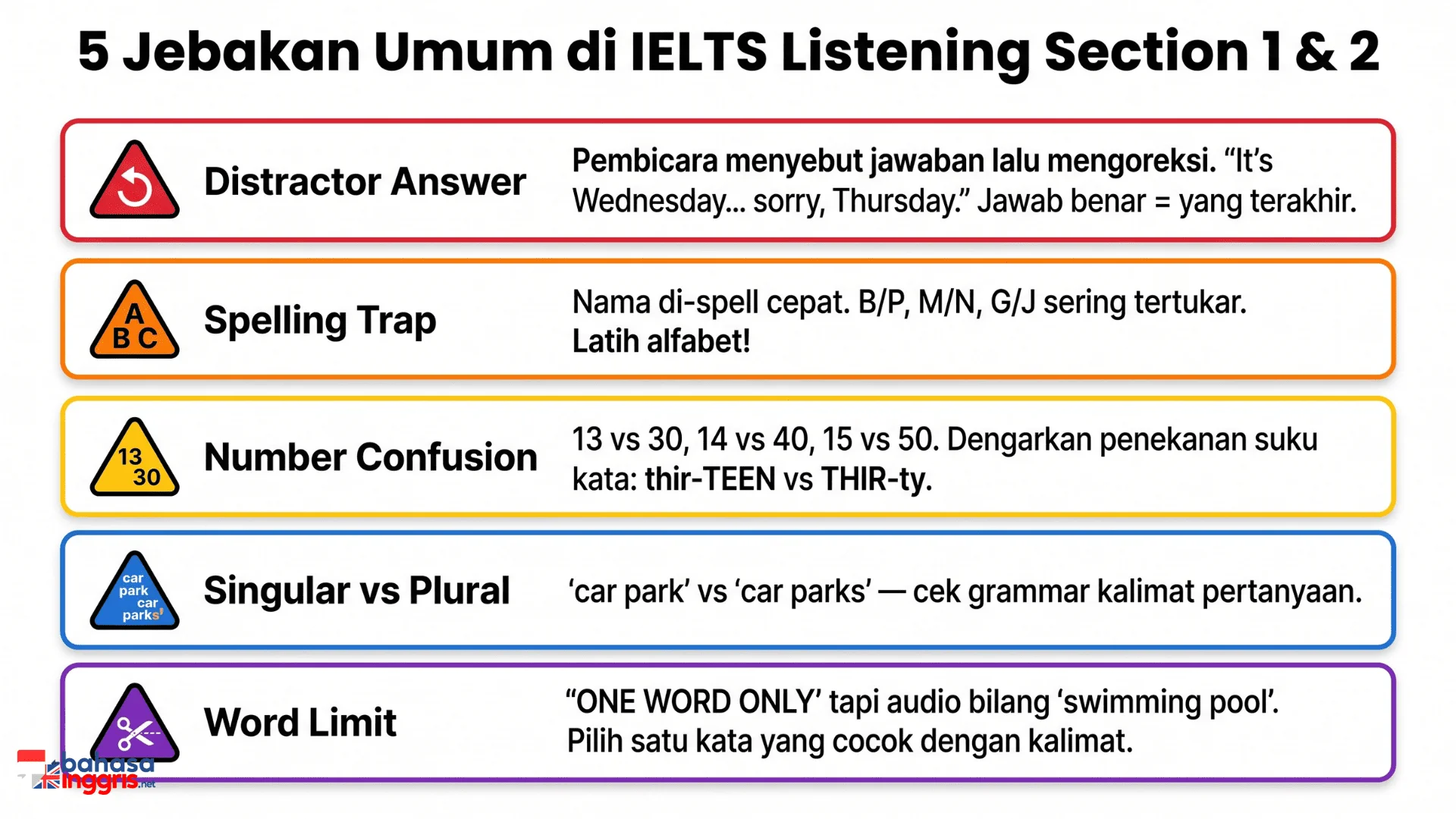
Jebakan Umum di Section 1 & 2
IELTS secara sengaja memasukkan jebakan untuk menguji apakah Kamu benar-benar mendengarkan dengan cermat. Berikut jebakan yang muncul di soal Cambridge 19 ini.
- Distractor Answer. Di soal 11, audio menyebutkan cheese factory DAN theme park DAN river trip. Tapi cheese factory hanya “learned about” (bukan highlight), theme park “had to be cancelled,” dan river trip adalah “the real highlight.” Jawaban: B. Selalu dengarkan evaluasi pembicara, bukan sekadar item yang disebut.
- Dua informasi mirip. Di soal 12, audio menyebut Malatte akan “building a footbridge” dan Stanthorpe akan “plant a tree.” Pertanyaan menanyakan apa yang terjadi di Stanthorpe, bukan Malatte. Baca lokasi di pertanyaan dengan cermat.
- Map labelling membutuhkan orientasi spasial. Di soal 16-20, Kamu harus mengikuti gerakan pembicara secara mental menggunakan peta. Identifikasi landmark tetap (car park, house, stables, lake) terlebih dahulu, lalu gunakan sebagai titik referensi.
- Sinonim dan parafrase. Audio bilang “have dinner in the house or garden rather than eating out” — soal menulisnya sebagai “have a meal at home.” Kamu harus mengenali bahwa kedua ungkapan ini bermakna sama.
(FAQ) Frequently Asked Questions
Apakah Section 1 selalu yang paling mudah?
Ya, Section 1 dirancang sebagai bagian termudah dari IELTS Listening. Percakapannya menggunakan bahasa sehari-hari dan jawabannya biasanya berupa informasi faktual seperti nama, tanggal, dan angka. Kebanyakan peserta seharusnya bisa menjawab 9-10 benar dari 10 soal di section ini.
Bagaimana strategi terbaik untuk soal map labelling?
Sebelum audio dimulai, pelajari peta dan identifikasi landmark tetap seperti pintu masuk, danau, atau jalan utama. Saat audio diputar, ikuti gerakan pembicara secara mental dari satu titik ke titik berikutnya. Perhatikan kosakata arah: north, south, far side, left-hand corner, dan sejenisnya.
Penutup
Section 1 dan 2 adalah fondasi skor Listening Kamu. Dengan latihan rutin dan perhatian khusus pada distractor answers, ejaan, dan orientasi peta, Kamu seharusnya bisa mengamankan 18-20 poin dari 20 soal di kedua section ini. Setelah fondasi ini kokoh, lanjutkan ke Section 3 & 4 untuk mendorong skor ke band 7+.
Untuk panduan strategi keseluruhan, baca Panduan IELTS Listening. Untuk skill IELTS lainnya: Speaking Part 1, Part 2, Part 3, Writing Task 1, Writing Task 2. Kalau Kamu butuh bimbingan intensif dengan tutor, cek kelas IELTS online di Bahasa Inggris Net.

Panduan IELTS Listening: Strategi & Tips Skor Tinggi

IELTS Listening Section 3 & 4: Latihan Audio &...

