
IELTS Reading Passage 3: Latihan Soal Sulit dan Strategi
IELTS Reading Passage 3 adalah bagian tersulit dari seluruh tes Reading. Teks di Passage 3 biasanya lebih panjang (800-1000 kata), menggunakan kosakata akademik yang lebih kompleks, dan menyajikan argumen atau analisis yang berlapis-lapis. Jenis soal yang muncul juga cenderung lebih menantang: Matching Headings, Yes/No/Not Given yang menguji opini penulis, dan Multiple Choice yang membutuhkan pemahaman mendalam.
Daftar Isi
Banyak peserta yang menghabiskan terlalu banyak waktu di Passage 1 dan 2, lalu terburu-buru atau bahkan menebak seluruh Passage 3. Ini kesalahan fatal karena Passage 3 punya 14 soal — sepertiga lebih dari total. Artikel ini menyediakan satu passage latihan level sulit dengan jenis soal yang merepresentasikan apa yang akan Kamu temui di tes, lengkap dengan jawaban dan penjelasan strategi.
Passage 3: The Paradox of Choice in Modern Consumer Society
Waktu yang Disarankan: 23-25 menit
Baca passage di bawah ini, lalu jawab Questions 27-40.
A For centuries, the expansion of personal choice has been regarded as one of the hallmarks of human progress. The ability to choose one’s occupation, spouse, place of residence, and lifestyle were freedoms that previous generations fought to secure. In the realm of consumer goods, the proliferation of options has been similarly celebrated: more products, more brands, and more configurations are assumed to lead to better outcomes for consumers. Yet a growing body of psychological research suggests that this assumption may be fundamentally flawed. Rather than enhancing wellbeing, an excess of choice can lead to anxiety, dissatisfaction, and even paralysis.
B The seminal research in this area was conducted by psychologist Sheena Iyengar of Columbia University and Mark Lepper of Stanford University in 2000. In what has become known as the “jam study,” the researchers set up a tasting booth at an upscale grocery store on two separate occasions. On one day, the booth displayed twenty-four varieties of jam; on another day, it offered only six. While the larger display attracted more initial interest — sixty percent of passing shoppers stopped to look, compared to forty percent for the smaller display — the conversion to actual purchases told a dramatically different story. Only three percent of shoppers who encountered the twenty-four-jam display made a purchase, whereas thirty percent of those who saw the six-jam display bought a jar. The researchers concluded that while extensive choice was superficially attractive, it was functionally debilitating.
C Psychologist Barry Schwartz, in his influential 2004 book The Paradox of Choice, expanded on these findings by distinguishing between two types of decision-makers: “maximisers” and “satisficers.” Maximisers are individuals who strive to make the optimal decision by exhaustively evaluating all available options before committing. Satisficers, by contrast, establish a set of criteria for what constitutes a “good enough” option and select the first alternative that meets those criteria. Schwartz argued that in environments with limited choices, the distinction between these two groups is relatively inconsequential. However, as the number of options increases, maximisers experience disproportionate increases in stress, regret, and decision fatigue, while satisficers remain largely unaffected.
D The mechanisms through which excessive choice undermines satisfaction are multifaceted. One key factor is the escalation of expectations. When only a few options are available, consumers tend to accept that no single product can perfectly meet their needs. But when hundreds of options are presented, the implicit message is that the perfect choice exists — the consumer simply needs to find it. This creates an unrealistic standard against which the eventually selected product is inevitably judged. A second mechanism is the amplification of opportunity cost. With every additional option, the consumer becomes more acutely aware of the attractive features of rejected alternatives. The chocolate cake would have been enjoyable, but the awareness that the lemon tart or the tiramisu might have been better introduces a persistent undercurrent of doubt.
E Not all researchers accept the paradox of choice as a universal phenomenon, however. A comprehensive meta-analysis conducted by Benjamin Scheibehenne and colleagues in 2010, which examined fifty published and unpublished studies on the effect of choice overload, found that the average effect size across all studies was virtually zero. Some studies replicated Iyengar and Lepper’s findings, while others found no effect or even the opposite — that more choice led to better outcomes. Scheibehenne’s team concluded that the relationship between choice and satisfaction is moderated by several contextual factors, including the decision-maker’s expertise, the complexity of the options, and the importance of the decision.
F Subsequent research has attempted to identify the conditions under which choice overload is most likely to occur. A 2015 study by Alexander Chernev and colleagues at Northwestern University identified four key moderators. First, choice overload is more likely when options are difficult to compare — for instance, when they differ along multiple dimensions rather than a single attribute. Second, it is more pronounced when the decision-maker has no strong prior preferences. Third, the effect is amplified when the stakes of the decision are perceived as high. Fourth, choice overload increases when the decision-maker expects to feel accountable for the outcome, such as when buying a gift for someone else.
G The implications of this research extend well beyond supermarket aisles. In healthcare, patients are increasingly asked to choose between treatment options, insurance plans, and providers. While patient autonomy is a valuable principle, research by Dr. Peter Ubel of Duke University has shown that patients with limited medical knowledge often experience greater anxiety when presented with multiple treatment options compared to those who receive a single recommendation from their physician. Similarly, in the financial sector, the proliferation of investment products, pension plans, and insurance policies has been associated with lower participation rates. A study of American retirement savings found that for every ten additional investment funds offered in a company’s pension plan, employee participation declined by approximately two percent.
H Companies and policymakers have begun to respond to these findings. Some retailers have reduced the number of product variants on their shelves, finding that a curated selection often outperforms an exhaustive one. Procter and Gamble, for example, reduced the number of Head and Shoulders shampoo varieties from twenty-six to fifteen and saw a ten percent increase in sales. In the public policy arena, the concept of “choice architecture,” popularised by economists Richard Thaler and Cass Sunstein, advocates designing decision environments that guide individuals toward beneficial outcomes without restricting their freedom. Default enrolment in pension schemes, organ donation registries, and standardised health insurance plans are all examples of this approach.
I The challenge for modern societies, then, is not to eliminate choice but to structure it thoughtfully. Schwartz himself has acknowledged that some degree of choice is essential for autonomy and motivation, and that the goal should be to find the “optimal amount of choice” rather than to minimise it entirely. What the research consistently demonstrates is that the assumption “more is always better” does not hold in the domain of human decision-making. Understanding when and why choice becomes burdensome is essential for designing systems — whether commercial, medical, or governmental — that genuinely serve the people who use them.

Questions 27-32: Match each paragraph (B-H) with the correct heading below.
Choose the correct heading for each paragraph from the list below.
List of Headings
i. The original experiment that revealed choice overload
ii. How businesses and governments have adapted
iii. Why some researchers dispute the choice overload theory
iv. Two psychological types of decision-makers
v. The impact of excessive choice on professional fields
vi. Conditions that make choice overload more likely
vii. How expectations and regret increase with more options
viii. The need to return to simpler lifestyles
ix. Historical context of the freedom to choose
27. Paragraph B ………
28. Paragraph C ………
29. Paragraph D ………
30. Paragraph E ………
31. Paragraph F ………
32. Paragraph G ………
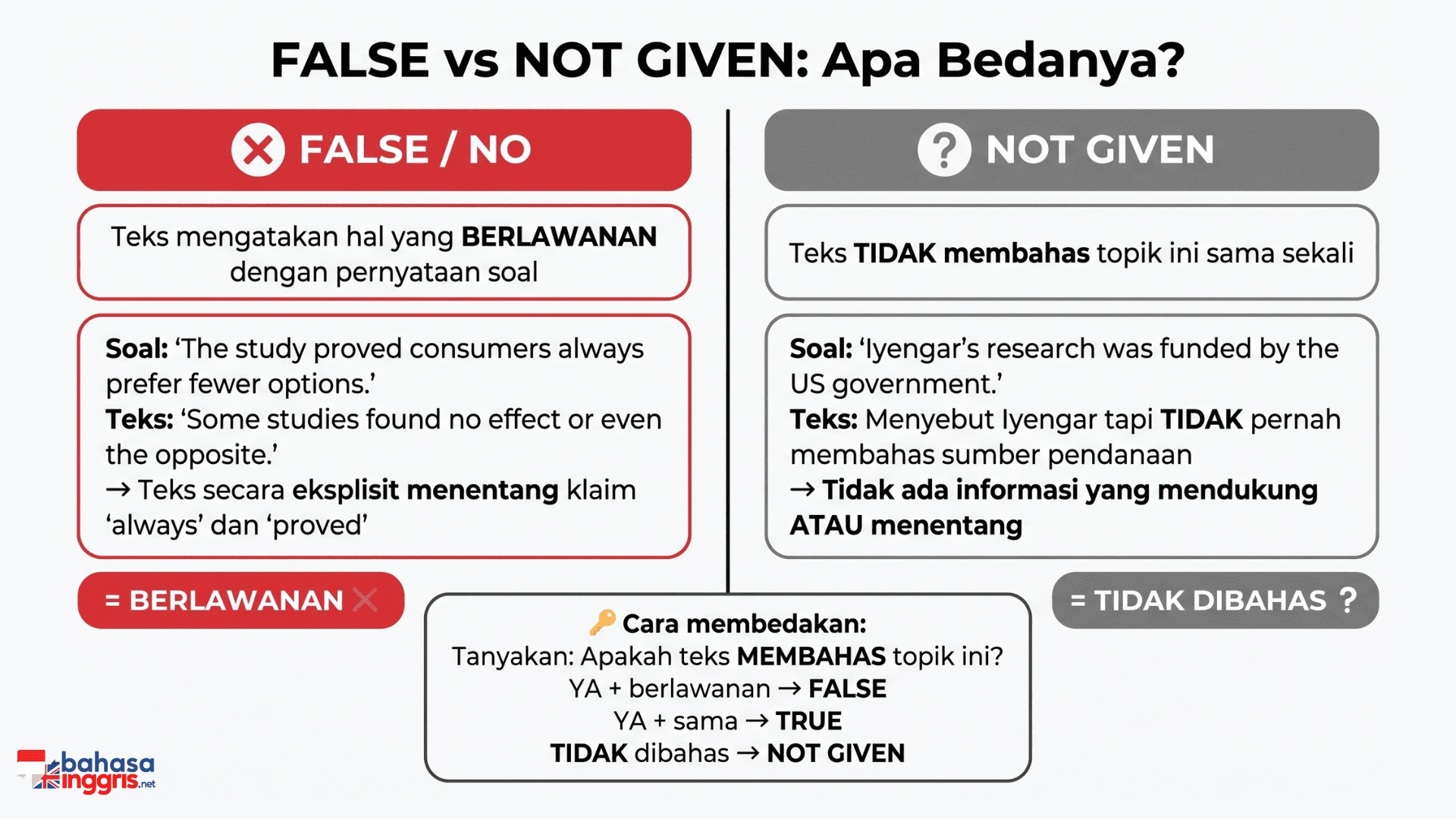
Questions 33-36: Yes / No / Not Given
Do the following statements agree with the claims of the writer?
33. The jam study proved that consumers always prefer fewer options.
34. Satisficers are generally happier than maximisers when faced with many choices.
35. Scheibehenne’s meta-analysis completely disproved the paradox of choice theory.
36. Default enrolment in pension schemes restricts individual freedom.
Questions 37-40: Complete the sentences below. Write NO MORE THAN THREE WORDS from the passage for each answer.
37. The jam study found that only ___________ of shoppers bought jam from the larger display.
38. According to Schwartz, maximisers experience increased stress, regret, and ___________ as options increase.
39. Procter and Gamble reduced shampoo varieties and experienced a ___________ increase in sales.
40. Schwartz suggests that the goal should be finding the ___________ rather than eliminating choice entirely.
Klik untuk melihat jawaban Passage 3
27. i (The original experiment that revealed choice overload)
28. iv (Two psychological types of decision-makers)
29. vii (How expectations and regret increase with more options)
30. iii (Why some researchers dispute the choice overload theory)
31. vi (Conditions that make choice overload more likely)
32. v (The impact of excessive choice on professional fields)
33. NO (the study showed this in one context, but later research showed mixed results — the writer doesn’t claim it’s universal)
34. YES (paragraph C: maximisers experience “disproportionate increases in stress, regret” while satisficers “remain largely unaffected”)
35. NO (the meta-analysis found “average effect size was virtually zero” but didn’t disprove it completely — some studies replicated findings)
36. NO (paragraph H says choice architecture guides people “without restricting their freedom”)
37. three percent
38. decision fatigue
39. ten percent
40. optimal amount of choice
Strategi Passage 3
Untuk Matching Headings: Ini sering jadi jenis soal pertama di Passage 3 dan paling menghabiskan waktu. Jangan baca seluruh paragraf. Baca hanya kalimat pertama dan kalimat terakhir setiap paragraf untuk mengidentifikasi ide utama. Cocokkan dulu heading yang paling jelas, lalu eliminasi untuk heading yang ambigu. Ingat: heading menangkap IDE UTAMA, bukan detail.
Untuk Yes/No/Not Given: Ini menguji OPINI penulis, bukan fakta. Perhatikan kata-kata yang menunjukkan sikap penulis: “suggests,” “argues,” “has noted,” “however.” Soal 35 adalah jebakan klasik: meta-analysis menemukan “virtually zero” average effect, tapi penulis juga menulis “some studies replicated findings” — artinya TIDAK sepenuhnya disproved. Jawaban: NO.
Untuk Sentence Completion: Jawaban harus kata yang persis ada di teks, bukan parafrase Kamu. Scan teks untuk menemukan kalimat asli, lalu salin kata yang tepat sesuai word limit.
(FAQ) Frequently Asked Questions
Kenapa Passage 3 jauh lebih sulit?
Passage 3 lebih sulit karena tiga alasan: teksnya lebih panjang dan menggunakan kosakata akademik yang lebih kompleks, argumennya berlapis-lapis dengan beberapa perspektif yang saling bertentangan, dan jenis soal seperti Matching Headings dan Yes/No/Not Given membutuhkan pemahaman yang lebih dalam dari sekadar menemukan informasi spesifik.
Apa perbedaan antara False dan Not Given di IELTS Reading?
FALSE/NO berarti teks secara eksplisit menyatakan hal yang berlawanan dengan pernyataan soal. NOT GIVEN berarti teks tidak membahas topik tersebut sama sekali. Kalau Kamu tidak bisa menemukan informasi yang mendukung atau menentang pernyataan soal di mana pun dalam teks, jawabannya NOT GIVEN.
Penutup
Passage 3 adalah tempat yang menentukan apakah skor Kamu bertahan di band 6.5 atau naik ke band 7+. Kunci utamanya: alokasikan 23-25 menit (bukan sisa waktu), kuasai Matching Headings dengan teknik baca kalimat pertama-terakhir, dan pahami perbedaan Yes/No/Not Given yang menguji opini penulis.
Untuk fondasi yang lebih kuat, pastikan Kamu sudah menguasai Passage 1 & 2. Baca juga Panduan IELTS Reading untuk strategi keseluruhan. Untuk skill lainnya: Listening, Speaking Part 1, Part 2, Part 3, Writing Task 1, Writing Task 2. Kalau Kamu butuh bimbingan intensif dengan tutor, cek kelas IELTS online di Bahasa Inggris Net.

IELTS Reading Passage 1 & 2: Latihan Soal dan...

Apakah TOEFL Takers Bisa Pindah ke IELTS? (Panduan Beasiswa)

